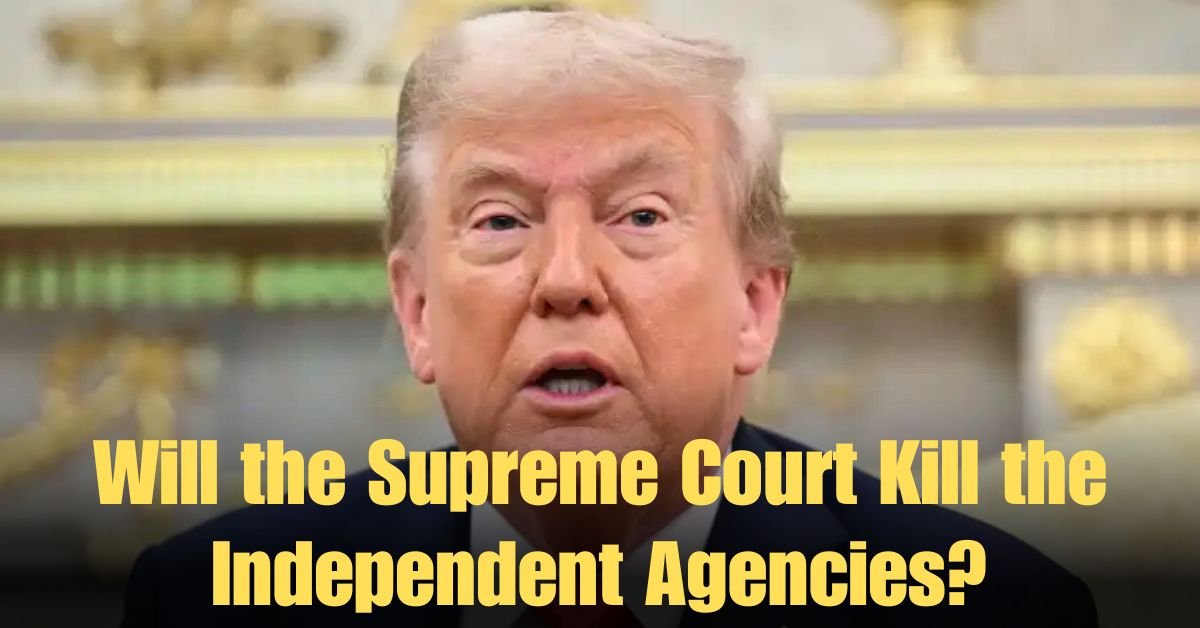
The Supreme Court is on the verge of handing down a landmark decision that could completely remake the federal government to giving the President unprecedented executive power over agencies designed to be free from political interference.1
At the center of this legal earthquake is the firing of a single official. Rebecca Kelly Slaughter a Democratic appointed commissioner on the Federal Trade Commission (FTC). Fired by President Donald Trump without citing the statutory “for cause” removal criteria, her case Trump v. Slaughter has become the ultimate test of the President’s Firing Authority/Removal Power and the 90 year old legal precedent that has protected regulatory independence.
This article breaks down the high stakes battle between presidential authority and congressional limits, explaining why the future of consumer protection and antitrust enforcement hangs in the balance.
The Unitary Executive Theory vs. The Independent Agencies
The core of the dispute rests on a fundamental disagreement over the separation of powers established in the Constitution.
The President’s Argument. The Unitary Executive
The Trump administration’s legal team is championing the Unitary Executive Theory. This conservative legal argument asserts that under Article 2 of the Constitution, which vests the “executive Power” in the President the Chief Executive must have sole authority over the entire executive branch including the power to remove any appointed official at will.
According to this theory, Congress cannot through legislation insulate from political pressures officials who exercise substantial Regulatory Power and Executive Power. Advocates including the U.S Chamber of Commerce see these restrictions as an unconstitutional encroachment on the President’s control over policy implementation.
Key Concept. The Unitary Executive Theory holds that the President must have unfettered control including removal power over all parts of the executive branch to be held accountable for its actions.
The Agency’s Defense: The Removal for Cause Precedent
Independent Federal Agencies like the FTC were created by Congress to operate with expertise and impartiality making decisions based on law and data not shifting political winds.
The 1914 law establishing the FTC states that commissioners can be removed only “for cause,” meaning only for defined reasons like “inefficiency, neglect of duty or malfeasance in office.” This statutory protection is designed to prevent a President from firing an agency head merely for policy disagreement.
This structure was upheld by a landmark Supreme Court ruling in 1935 Humphrey’s Executor v. United States. This precedent confirmed Congress’s right to place limits on presidential removal for agencies performing quasi legislative and quasi judicial functions. Overturning this bedrock case would drive the final nail into the coffin of true independent agency status.
The Stakes: Why This Case Matters Beyond the FTC
While Trump v. Slaughter centers on the FTC commissioner the ruling will impact nearly two dozen other agencies with similar “for cause” protections.
| Agency Type | Primary Function | Potential Impact of Loss of Independence |
| FTC | Antitrust Enforcement, Consumer Protection | Policy decisions could swing wildly with each new administration potentially weakening protections for consumers and allowing more corporate consolidation. |
| CPSC | Health and Safety | Regulations on product safety could be easily halted or reversed to favor business interests. |
| EEOC | Workplace Discrimination | Enforcement of equal employment laws could be subject to immediate political pressure. |
| Federal Reserve | Monetary Policy (Unique Structure) | Though the court has suggested the Fed is “uniquely structured” (see the related Lisa Cook case) a broad ruling could still destabilize the central bank. |
The “Deep State” and MAGA Movement
The aggressive pursuit of this Firing Authority is not isolated. It aligns with a broader goal of the Trump Administration and the MAGA Movement to remake the federal government and dismantle what they term the “shadowy unaccountable” “Deep State.”
Also Read: Trump Unleashes on Pardoned Democrat Henry Cuellar After Reelection Announcement
For Allied Business Interests gaining immediate control over Regulatory Power represents a massive win, allowing for the quick rollback of rules related to the environment, labor and finance.
FAQs
What is Humphrey’s Executor v United States 1935?
It is the Supreme Court case that unanimously upheld Congress’s ability to limit the President’s power to remove commissioners of the FTC (and other independent agencies) only for specified reasons like “inefficiency and neglect of duty or malfeasance in office,” rather than at the President’s will.
What is the “Shadow Docket”?
The term “Shadow Docket” refers to the Supreme Court using Emergency Orders (like the ones allowing Trump to remove Slaughter and others while the main case proceeded) without hearing oral arguments or providing detailed rulings.The use of this docket in these high stakes constitutional cases has drawn considerable criticism.
What is the main legal question the Supreme Court is deciding?
The main question is whether the 1935 precedent set in Humphrey’s Executor which permitted Congress to place Removal for Cause restrictions on the President’s power to remove heads of independent agencies should be overturned as a violation of the Unitary Executive Theory.
Disclaimer:
This article is for informational and educational purposes only and provides an analysis of a current legal case (Trump v. Slaughter) before the U.S Supreme Court. It is based on publicly available information legal arguments presented by the involved parties and judicial commentary.