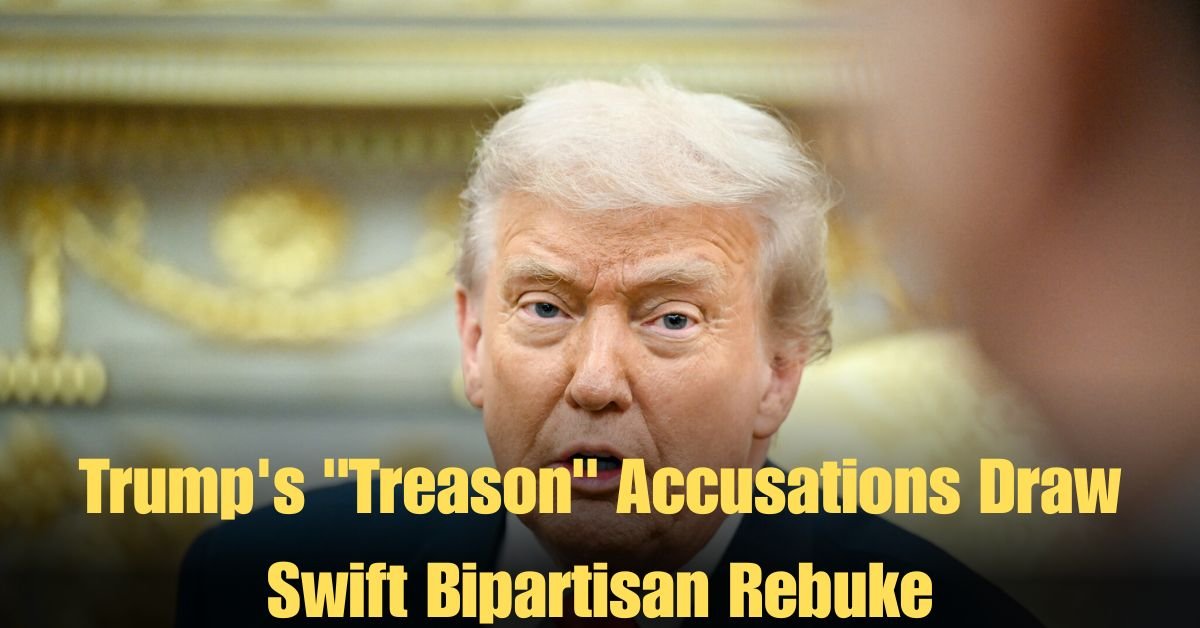
In a deeply polarized political climate moments of bipartisan rebuke against a sitting president are rare and highly significant. Recently President Donald Trump’s comments accusing Democratic lawmakers of “seditious behavior” and treason following a video aimed at members of the military have ignited a firestorm unifying critics across the political aisle.
The controversial comments which invoked the severe penalty of death focused on a video where Democratic veterans and lawmakers including Senator Elissa Slotkin encouraged service members to refuse illegal orders. This rhetoric has elevated the political debate to extreme constitutional and legal grounds forcing a public discussion on political rhetoric the duty of soldiers and the boundary between dissent and treason threat.
The Core Conflict Seditious Behavior vs. Duty to Disobey
The controversy stems from a video by Democratic Lawmakers who are also veterans. The video explicitly reminded Members of the Military and intelligence community that they are obligated to refuse an illegal order a long-established principle within the Uniform Code of Military Justice (UCMJ).
The UCMJ specifies that a service member can only be punished for disobeying a lawful command. The legal duty to disobey arises only when an order is “manifestly, patently unlawful,” meaning any person of ordinary understanding would know it is criminal such as an order to commit murder.
In response President Donald Trump labeled the video and its creators as engaging in “seditious behavior.” Legal experts note that the President often uses terms like sedition and treason broadly and inappropriately for rhetorical effect.
The Legal Distinction
| Crime | U.S. Legal Definition (18 U.S. Code) | Penalty |
| Treason | Narrowly defined by the Constitution. Consists only of levying war against the U.S. or adhering to its enemies, giving them aid and comfort. | Punishment of Death or imprisonment (Maximum). |
| Sedition. | Incitement of rebellion against the government is often through speech or writings that tend toward rebellion. | Imprisonment (Up to 20 years for Seditious Conspiracy). |
Uniting the Political Factions The Bipartisan Rebuke
The severity of the President’s language specifically the mention of the Punishment of Death triggered immediate pushback demonstrating a rare instance of unity against polarizing Political Rhetoric.
- Democratic Response (Sen. Elissa Slotkin). Slotkin a former CIA analyst did not back down. She characterized the President’s attack as “tool of fear,” arguing that he is attempting to silence critics. More strategically she claimed the accusations were a Distraction Tactic intended to divert public attention from “big stories” like the ongoing fallout from the Jeffrey Epstein Files and concerns over The Economy.
- Republican Distance . Even with in the President’s own party key figures sought to distance themselves. Republican Rep is publicly stated that he does not “speak for the president in terms of hanging members of Congress” and called for the President to “tone down the rhetoric.” This calculated step away from the inflammatory language signals concern that the Treason Threat goes behind mere political sparring.
The fact that the pushback came from prominent figures on both sides underscores a shared concern over the dangerous weaponization of constitutional law terminology in political discourse.
Analyzing the Intent Beyond Political Squabbling
The choice of words like “treason” and “sedition” is unusual in peace time political rhetoric and serves several strategic purposes.
- Emotional Trigger. These terms bypass rational political debate and tap directly into powerful, primal fears about national security and betrayal to serving as an effective tool of fear.
- Narrative Framing. By framing the opposition’s actions as an existential threat to the nation the President attempts to delegitimize their entire political platform.
- Distraction Tactic. As Senator Slotkin suggested that inflammatory language is often employed to dominate the news cycle and push less favorable topics such as the state of The Economy out of the spotlight.
This activity highlights the increasing trend of political leaders using extreme language to polarize the electorate and forming principled bipartisan rebuke from both Democratic and Republican representatives the crucial check on presidential power.
Also Read: Umahi Announces Coastal Highway Section Opening for December Traffic
Share Your Thoughts
Does the use of words like “treason” cross an un acceptable line in political discussion?
Does bipartisan rebuke successfully temper the use of such political language?
Comment below with your perspective on how lawmakers should address future Treason Threats and the duty of members of the military to refuse orders.
Disclaimer
This article reports on political commentary and legal opinions surrounding the use of specific terminology in political discourse.
The content is particularly the distinctions between Treason and Sedition and the references to the Uniform Code of Military Justice (UCMJ) is provided for informational and educational purposes only. This is not intended as legal advice, nor should it be interpreted as a definitive legal analysis of the statements made by either President Trump or the Democratic lawmakers.