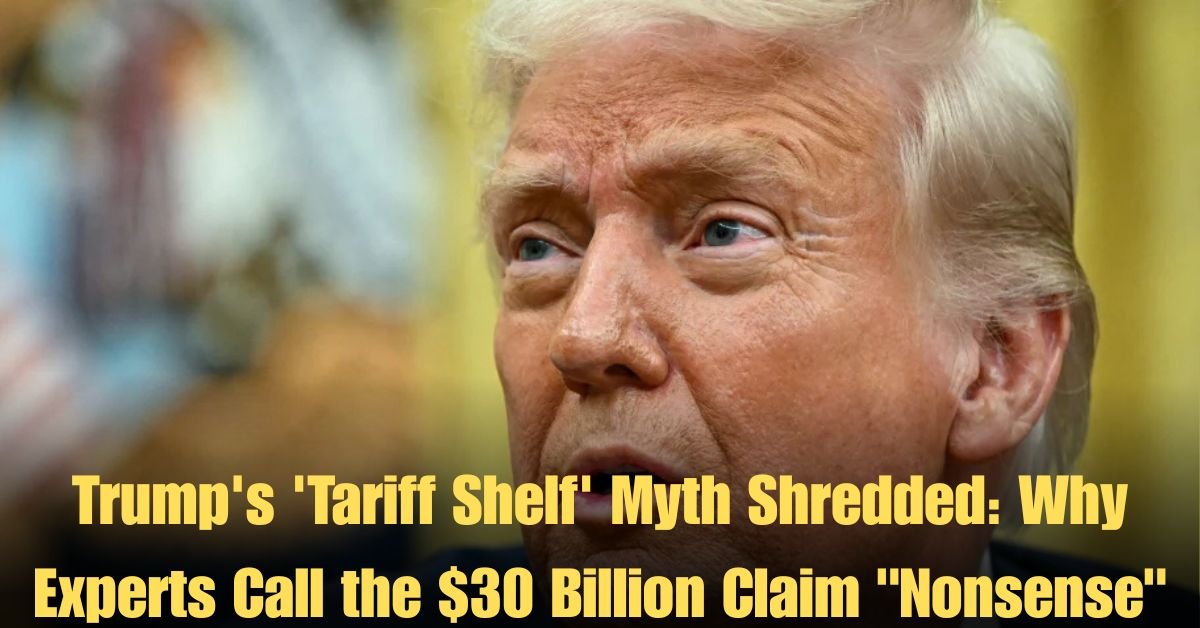
President Donald Trump recently resurrected his now infamous claim that the U.S. government is “finding money” it “never knew existed” on a mysterious “Tariff Shelf.” Specifically the President cited a sudden discovery of $30 Billion to attributing the windfall entirely to his Tariffs and suggesting this new revenue could fundamentally change Federal Accounting.
The White House rhetoric quickly drew fire from critics and Economists alike who call the Trump’s Tariff Tale a persistent and nonsensical False Claim.
Why are experts so quick to shred this narrative?
Because the entire concept of a “tariff shelf” where surprise money is stored is a political Rhetorical Digression that ignores economic reality and the mechanics of Revenue Generation.
Deconstructing the “Imaginary Tariff Windfall”
The core claim that a government official “checked the tariff shelf” and found $30 billion is not just an exaggeration it’s a fiction that misrepresents how U.S. government funds are handled.
The Reality of Federal Accounting
- No “Shelf” Exists. Tariffs are Customs Duties (taxes on imported goods) collected by U.S Customs and Border Protection (CBP) at ports of entry. This revenue is automatically deposited into the General Fund of the United States Treasury Department. There is no separate hidden “Tariff Shelf” account to be “discovered.”
- A Tiny Revenue Share. Even with the high duties imposed by the Administration tariffs accounted for only about 1.57% of total federal revenue in FY2024. The total amount collected is nowhere near the figure required to offset major federal programs or replace the massive revenue stream from the Individual Income Tax prospect Trump has often linked to his Tariff Tale.
- The Math Doesn’t Add Up. As the Yale Budget Lab and other financial experts confirm, Tariffs simply could not generate the $2.8 trillion needed to replace income tax. Pushing the effective tariff rate high enough to achieve that goal (estimated at 20% to 30% or higher) would cause Import Taxes and Consumer Prices to rise so dramatically that Americans would stop buying most imported goods, causing the revenue to collapse.
“Of all the things that didn’t happen this didn’t happen the most,” snarked one observer on X (formerly Twitter) highlighting the widely perceived Financial Absurdity of the claim.
The Hidden Cost. Tariffs and Consumer Impact
While the “Tariff Shelf” Myth might be dismissed as Political Hyperbole, the policies underpinning it have very real economic consequences particularly for American families.
The Regressive Nature of Import Taxes
- Consumers Bear the Cost. The burden of Tariffs is entirely paid by U.S. importers (American companies) who then pass the increased costs onto Consumer Prices. This makes tariffs regressive tax that dis proportionately harms low and middle income households.
- Expert Consensus. Economists at Yale University have consistently warned that the tariffs enacted under the administration result in massive losses of purchasing power. The Yale Budget Lab estimated that the cumulative effect of the Trade Policy changes translated to an average consumer loss of upwards of $3800 per household in one recent year.
The Legal Jeopardy of Presidential Authority
Also Read: Twisted Killer Levi Aron Dies in Prison
The viability of the entire tariff program is currently under intense legal scrutiny moving the focus from Recycled Whopper to high-stakes Tariff Litigation.
- Supreme Court Review. The Supreme Court has agreed to hear cases challenging the Presidential Authority used to impose the tariffs specifically under the International Emergency Economic Powers Act (IEEPA).
- Trillions at Stake.If the Supreme Court rules against the Administration it could force the government to refund importers an estimated $750 billion to $1 trillion in duties already collected. This looming risk underscores the financial instability caused by using an emergency law rather than Congressional Authority to implement a massive long term trade tax.
FAQs
Is there any legal or accounting term for a “Tariff Shelf”?
No. The “Tariff Shelf” is purely a political phrase. Tariffs are legally defined as Customs Duties and are immediately registered as revenue by the Treasury Department in the General Fund they do not sit on a physical or metaphorical shelf waiting to be found.
How does the $30 Billion Tariff Claim compare to actual tariff revenue?
In a recent fiscal year U.S Customs and Border Protection collected around $77 billion in total Tariffs. The mention of “found” $30 billion suggests a major discovery but experts agree this number like the story behind it is simply an example of False Claims.
What is the main argument in the Supreme Court Review of the tariffs?
The argument in the Supreme Court Review is whether the IEEPA law intended for addressing genuine national emergencies grants the President the authority to impose broad revenue raising Tariffs which is typically considered power reserved for Congress under the U.S Constitution.
Call To Action
Understanding the real economic impact of Tariffs versus the political expression is crucial for informed public discussion.
Did this article clarify the reality behind the “Tariff Shelf” Myth?
Share this breakdown with others and subscribe to our newsletter for more expert analysis of trade and fiscal policy straight to your inbox!