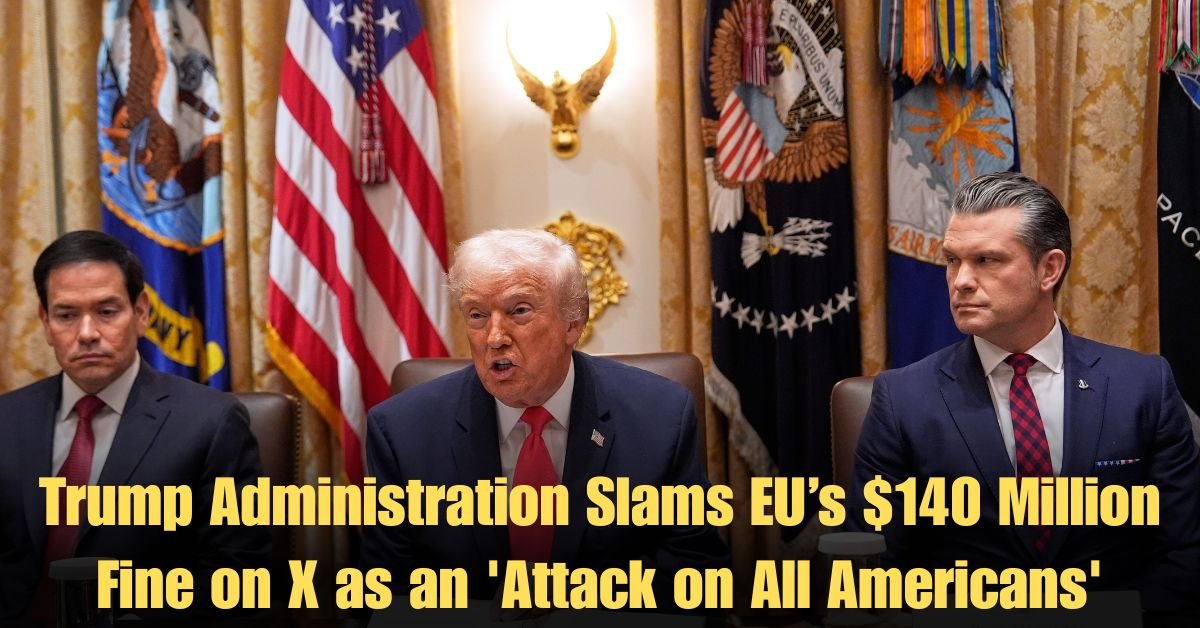
The digital world is reeling from a major transatlantic regulatory battle. On Friday the Trump Administration issued a fierce condemnation of the European Commission’s decision to slap Elon Musk’s social media platform X (formerly Twitter) with a massive $140 million fine.
Senior U.S officials including Secretary of State Marco Rubio and Vice President JD Vance immediately framed the penalty not just as a financial punishment on a single corporation but as a hostile “attack on all American tech platforms and the American people” by foreign governments seeking to impose censorship. This dramatic clash highlights a fundamental divide between the U.S and Europe over free speech principles and the extent of Big Tech regulation.
The European Commission’s Stance: Violating the DSA
The penalty represents the first major non compliance decision issued under the European Union’s sweeping new regulation the Digital Services Act (DSA).The DSA a key piece of legislation focused on creating a safer more transparent online environment for European users requires very large platforms to take greater responsibility for policing content and operating with rigorous transparency requirements.
The EU regulators cited three core violations of the DSA’s transparency rules by X
- Deceptive Design of Blue Checkmarks. The Commission found that the new system where anyone can pay $8 for a blue checkmark constitutes a “deceptive design practice.” This shift from a verification badge of authenticity to a paid feature exposes users to scams and manipulation as it becomes difficult to judge the true identity behind an account.
- Lack of Transparency in the Ad Database. X was found to have violated rules requiring a publicly accessible and detailed ad database (repository of digital advertisements). Regulators argued that design features and access barriers such as excessive delays in processing requests, undermined the database’s purpose, hindering researchers trying to detect fake ads and coordinated influence campaigns.
- Barriers for Researchers. The platform was accused of putting up “unnecessary barriers” that stymied research into systemic risks faced by users. This lack of access to public data inhibits independent experts from providing crucial oversight.
Henna Virkkunen the EU’s executive vice president for tech sovereignty, security and democracy defended the ruling, stating “Deceiving users with blue checkmarks and obscuring information on ads and shutting out researchers have no place online in the EU. The DSA protects users.”
The American Counter Attack. Free Speech vs. Regulation
The response from the Trump Administration was swift and focused on the ideological contrast between U.S and EU approaches to digital governance.
Secretary of State Marco Rubio posted on X, claiming the fine was a calculated effort to punish a U.S company for its commitment to free speech. This sentiment was echoed by Vice President JD Vance who accused the European Commission of punishing X “for not engaging in censorship” and urged the EU to support free speech instead of “attacking American companies over garbage.”
The rhetoric escalated with U.S Federal Communications Commission chair Brendan Carr who characterized the fine as Europe “taxing Americans to subsidize a continent held back by Europe’s own suffocating regulations.“
Also Read:Taraba Governor Kefas provides official vehicles for new LG chairmen
This political firestorm boils down to differing viewpoints on the digital public square:
- The U.S View (as articulated by the Administration). Views the aggressive regulation of American tech firms as a protectionist attack and a breach of American free speech traditions (which heavily protect nearly all speech from government interference).
- The EU View.Argues that platforms must assume greater responsibility to protect their citizens from systemic harms, deception and misinformation to prioritizing user safety and data access over the companies’ operational freedom.
FAQs
What is Digital Services Act?
The Digital Services Act is a comprehensive set of EU regulations that requires major online platforms like X to better protect their European users from illegal and harmful content, misinformation and other systemic risks. It imposes strict transparency requirements and mandates high level of accountability.
Why is the fine seen as “censorship” issue by U.S officials?
U.S. officials like Marco Rubio and JD Vance equate the EU’s aggressive oversight and mandatory content removal/mitigation rules with government-mandated censorship. They argue that the EU’s regulatory approach infringes on the American tradition of broad free speech protection.The EU conversely insists the fine is purely about a lack of transparency and not about content moderation.
What were the three main violations cited against X?
The European Commission cited three breaches of DSA rules:
Using the paid blue checkmarks as a deceptive design that misleads users about account authenticity.
The ad database having structural flaws and access barriers that reduce transparency for researchers.
Imposing unnecessary barriers to researchers seeking access to public data to study systemic risks.
Disclaimer:
This article reflects reported statements and regulatory actions. The views expressed by the U.S and EU officials represent distinct legal and political perspectives on digital regulation.