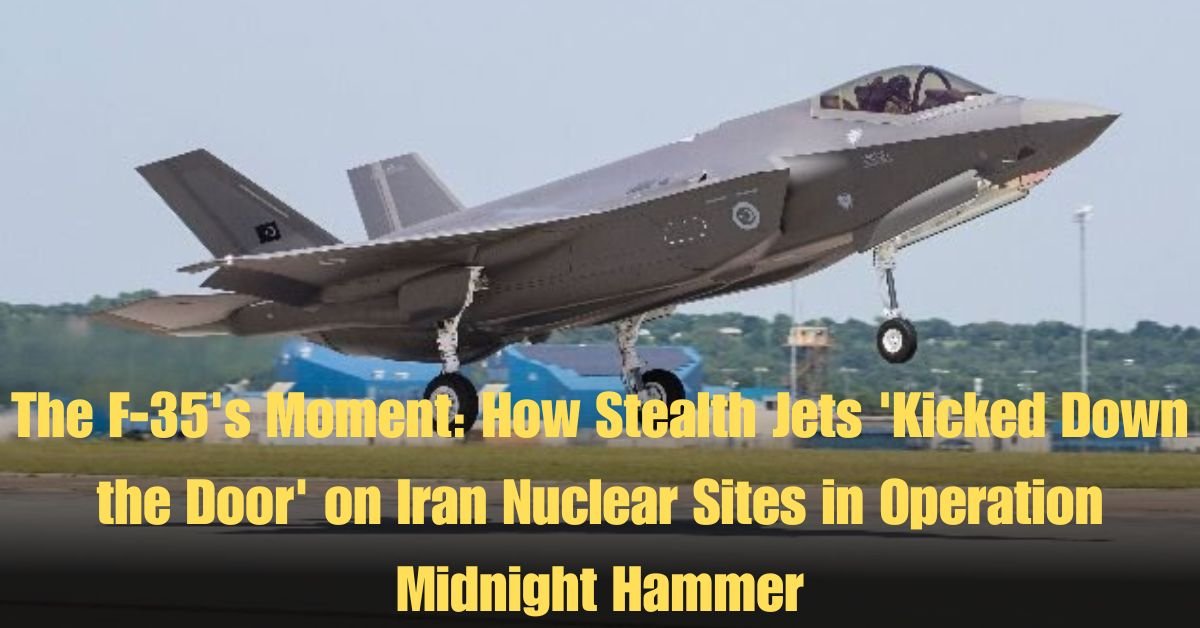
The Pentagon has finally pulled back the curtain on the most sensitive phase of Operation Midnight Hammer the June airstrikes against Iran. The stunning disclosure? It was not just the massive B 2 Stealth Bombers release 30,000 pound Massive Ordnance Penetrator (MOP) bombs that made history. It was the role of F 35 Stealth Jets show their worth as the undisputed force multiplier of the skies.
This mission targeting key Iran Nuclear Sites including the hardened facilities at Fordow, Natanz and Isfahan wasn’t just a strike it was a real world demonstration of Fifth Generation air power setting a stark new strategic benchmark. Find out how the F-35A single handedly neutralized Iranian air defense forces and why this success has huge implications for the looming strategic challenge in the Western Pacific against China’s Anti access and Area Denial (A2/AD) network.
SEAD and the Art of ‘Kicking Down the Door’
The United States Air Force units specifically 388th Fighter Wing and its reserve associate 419th Fighter Wing from Hill Air Force Base, Utah were deployed to the Middle East with one critical task Suppression of Enemy Air Defenses (SEAD).
This mission colloquially known as “Kicking Down the Door,” demands an air craft with un matched low observable capabilities to penetrate deep into hostile contested airspace. That aircraft was the F 35A Lightning II.
F-35A’s Role in Midnight Hammer
- First In. The F-35 formation were the first American aircraft to breach Iranian airspace.
- SEAD Execution. They used their advanced Sensor Fusion technology, radar and electronic warfare suites to precisely locate, target and destroy multiple surface to air missile sites.
- Path Clearing. By suppressing the high end Iranian systems the F-35s effectively paved the way for the heavier less agile B 2 Stealth Bombers and F 22 Stealth Jets to safely reach their targets.
- Last Out. The F-35A jets provided fighter cover during the exit confirming the effectiveness of their lethality and survivability.
Lieutenant Colonel Aaron Osborne commander of the 34th Fighter Squadron under the 388th Fighter Wing confirmed the jets faced targeting attempts from “very high end systems” but were able to “detect and defeat” them performing exactly as designed.
MOP Bombs and the B-2 Spirit’s Precision Strike
The primary destructive phase of Operation Midnight Hammer was carried out by seven B-2 Stealth Bombers. Flying an 18 hour mission from Whiteman Air Force Base, Missouri these heavy hitters delivered 14 GBU-57 Massive Ordnance Penetrator (MOP) bombs.
The use of the MOP 30,000 pound bunker buster weapon was essential because the Iran nuclear sites at Fordow and Natanz are built deep underground requiring a specialized weapon only the B-2 is configured to carry. The combination of the F-35’s advanced SEAD capabilities and the B-2’s unparalleled payload and range proved that the U.S. can strike any hardened target on the globe with precision.
The Aftermath
Following strike on June 22 Iran react by launching ballistic missiles at Al Udeid Air Base in Qatar the next day. U.S. officials confirmed the react caused no U.S. casualties highlighting the defensive measures taken after the offensive mission was complete.
Global Implications. China A2/AD and Air Superiority
The disclosure of the F 35’s operational success is strategic message aimed far beyond the Middle East. The Pentagon explicitly linked the mission to the challenge posed by China’s military buildup in the Western Pacific.
China’s extensive Anti-access and Area Denial (A2/AD) networks are designed to keep U.S. forces especially aircraft carriers and large bases out of contested zones. The successful penetration of Iran’s integrated air defense system by the F-35 provides a template for how the U.S. would attempt to neutralize comparable or even more advanced systems built by a near-peer competitor.
Colonel Charles Fallo commander of 388th Fighter Wing summarized the impact to stating the strike “validated all of the capabilities of the F 35 we’ve been talking about for years stealth, lethality, sensorfusion being a force multiplier.” This mission solidifies the F 35 family including the F 35B (STOVL) and F 35C (carrier variant) the core of future U.S and allied air superiority doctrine.
FAQs
What is Sensor Fusion on F 35?
Sensor Fusion is the jet’s ability to automatically collect and process data from all its internal sensors (radar, optical systems and electronic warfare) into a single comprehensive easy to understand battlespace awareness picture for pilot giving them an unmatched informational advantage.
What are three variants of the F 35?
F-35A (CTOL). Conventional Takeoff and Landing (Air Force, used in this strike).
F-35B (STOVL). Short Takeoff, Vertical Landing (Marines/Navy).
F-35C (CV). Carrier Variant (Navy).
Did the F 35s fire Massive Ordnance Penetrator bombs?
No The GBU 57 MOP bombs are large for the F 35. They were dropped exclusively by the B 2 Stealth Bombers. The F 35’s job was to destroy the surface to air missile sites to protect the bombers.
Disclaimer:
This article is a report and analysis based on public disclosures and statements made by the United States Air Force and Pentagon officials regarding Operation Midnight Hammer While every effort has been made to ensure accuracy based on available sources information related to military operations and specific capabilities of the F-35 Stealth Jets may be subject to operational security restrictions.