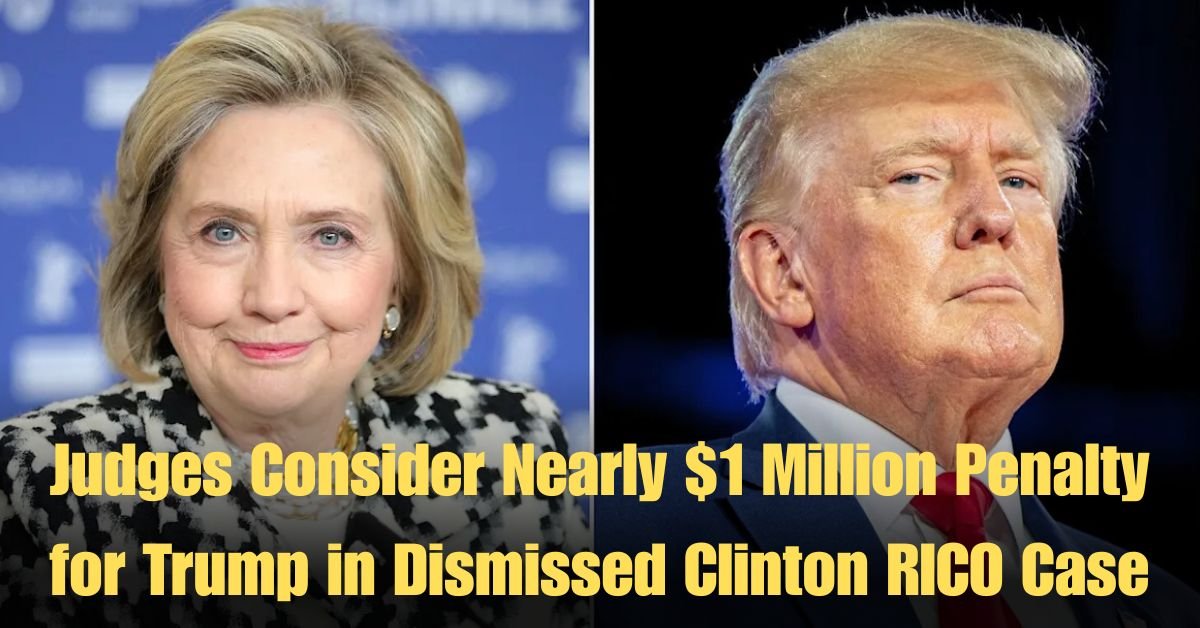
The legal battle over a political grudge has reached a critical stage at the U.S. Court of Appeals for the Eleventh Circuit. A three judge panel heard arguments on whether President Donald Trump’s sprawling racketeering lawsuit against Hillary Rodham Clinton, former FBI Director James Comey, and others should be reinstated and crucially whether the near $1 Million Penalty (totaling $938,000) in sanctions imposed against Trump and his former attorney, Alina Habba will stand.
The federal appeals court’s skepticism over the appeal underscores a key legal question to what extent can the judiciary be used to advance a political narrative and settle political grievances? The outcome will set a precedent for public figures seeking to use federal court for claims that critics argue are purely politically motivated.
Origins of the ‘Unthinkable Plot’ Lawsuit
The legal history began in 2022 when Trump filed lawsuit under the Racketeer Influenced and Corrupt Organization Act (RICO). The RICO case accused more than two dozen entities of orchestrating an “unthinkable plot” to create false narrative of Russia collusion during the 2016 presidential campaign.
The RICO Act federal law designed to target criminal enterprises through a pattern of illegal activity to requires specific stringent elements to be proven.
The Judicial Reprove. A ‘Shotgun Pleading’
In 2023, U.S. District Judge Donald Middlebrooks dismissed the case offering scathing judicial reprove. He characterized the 193 page complaint as a “shotgun pleading” a term used by the Eleventh Circuit to describe disordered complaints that fail to give defendants adequate notice of the claims against them .
Judge Middlebrooks concluded that the claims were legally insufficient and foreclosed by existing precedent because the lawsuit failed on multiple basic requirements for a civil RICO claim:
- No Enterprise: It did not plausibly identify a coordinated “conspiratorial enterprise.”
- No Predicate Acts: It failed to allege valid criminal predicate acts (the underlying crimes necessary for a RICO violation).
- No Damages: It did not demonstrate specific and quantifiable financial harm (pleading special damages).
- Time-Barred: It was filed outside the four-year statute of limitations.
In his sanctions order of Judge Middlebrooks was unequivocal, writing, “This case should never have been brought.No reasonable lawyer would have filed it.” He asserted that 31 individuals were “needlessly harmed” to dishonestly advance a political narrative.
The $938,000 Sanctions Imposed
The substantial financial penalties $938,000 were levied against both President Donald Trump and Alina Habba after the court found they had persisted with claims that demonstrated a clear lack of factual or legal grounding, despite repeated judicial warnings.
Trump’s appellate lawyer Richard Klugh argued at the hearing that the allegations of a “secret back-channel between the president and the Kremlin” constituted actionable injurious falsehood resulting in substantial reputational and business harm.
However Chief Judge William Pryor pressed the legal team sharply noting the failure to challenge every ground for the dismissal. Regarding the complaint’s form, Judge Pryor was blunt: “Mr Klugh, I can read this complaint, it’s a shotgun pleading. There’s no question about that, is there?“
The direct appeals court doubt signals a rugged road for Trump’s attempt to revive the dismissed lawsuit.
Also Read: Slain Teen Cruise Passenger Anna Kepner’s Stepbrother Named as Suspect
What Happens in Appellate Court?
The Eleventh Circuit panel which also involve Judge Andrew Brasher did not show when it would issue written ruling. The decision is expected in the coming weeks or months will have three possible outcomes:
- Affirmation: Upholding both the dismissal affirmed and the sanctions imposed. Trump and Habba would remain jointly responsible for the full amount.
- Partial Relief: Upholding the dismissal but reducing or eliminating the $1 Million Penalty.
- Reversal: Reviving some portion of the case and allowing it to move forward.
If the ruling affirms the sanctions, the case moves into enforcement. An affirmation of the dismissal would cement Judge Middlebrooks’ assessment that the action was primarily a political purpose vehicle not a viable legal claim. The question remains: how high is the cost of using the courts to wage a political war?
Disclaimer:
This report summarizes publicly available information regarding pending appeal and the opinions of presiding judges it does not represent a final legal judgment or predict the ultimate outcome of the case.The article includes statements of fact and opinion from judicial figures and legal representatives which are presented for context and reporting accuracy.