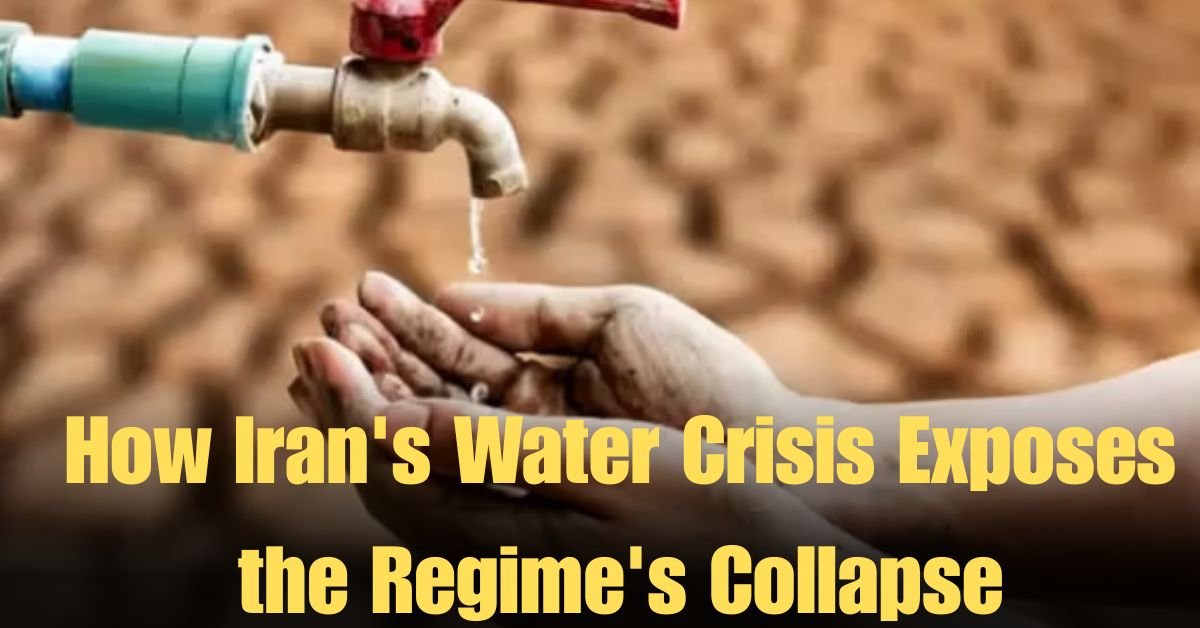
The specter of water rationing and even city evacuation hangs heavy over Tehran. Iran is capital and city of over 10 million is struggle with a profound water shortage as its five main reservoirs hold critically low levels a dire consequence of a multi year drought compounded by decades of political corruption.This is not just an environmental issue it is a full-blown hydrological crisis that is now serving as a critical test of legitimacy for Iran’s Ruling Clerical Regime.
The Catastrophic Scale of Water Crisis
The crisis extends far behind Tehran encompassing a national hydrological crisis of catastrophic proportions. Iran is classified by the World Resources Institute as one of the most water-stressed nations is facing an unjustifiable reality.
- Empty Rationing: The five reservoirs supplying Tehran are currently holding just 11 percent of their overall capacity (Source 1.1). In Mashhad the second largest city reservoirs have fallen below 3 percent capacity with three of four dams out of operation (Source 1.1). Officials in major cities are forced to implement the rolling water cuts especially at night (Source 2.2).
- Absolute Scarcity: Iran is endless water resources have plummeted by over one third in two decades. The per capita availability has loose from 4,500 9$\text{m}^3$ in 1976 to an estimated 850 10$\text{m}^3$ per person today placing the country firmly in the category of absolute water scarcity (Source 1.2, 2.1).
- Groundwater Collapse: Over extraction of ground water is expend aquifers at a rapid pace. Iran has approximately one million wells with about half estimated to be illegal (Source 1.2, 4.4). This is causing severe land subsidence with rates in the Tehran Plain exceeding 25 centimeters annually which is permanently reduces aquifer capacity (Source 1.2, 2.1).
This severe environmental stress intensified by climate change and inefficient irrigation, is leading to shrinking rivers/lakes (like the once-largest Middle Eastern lake, Lake Urmia) and rapidly deepening food insecurity as agriculture, which consumes up to 87% of the country’s freshwater, is devastated (Source 1.2, 2.2).
Skewed Priorities. Guns the Over Butter
At the core of Iran’s water woes lies political decision to prioritize revolutionary ambitions over basic infrastructure. The Iranian regime has consistently favored “guns over butter.”
While the cost of building one state of the art desalination plant is estimated to be around $1 billion the regime has poured untold billions of dollars into its nuclear program its arsenal of ballistic missiles and its extensive network of terrorist proxies (Source 3.1).
- Nuclear Priorities vs. Water Security: Estimates for Iran’s total investment in its nuclear infrastructure vary widely with some analyses suggesting the financial cost could be in the tens of billions of dollars (Source 3.4). One nuclear power plant project alone, Sirik, is expected to cost $20 billion (Source 3.3). By contrast Iran’s existing desalination plants only provide a mere 3% of the potable water for its nearly 92 million people (Source 3.1). For the cost of one major nuclear site Iran could have built an estimated 20 modern desalination plants (Source 3.1).
- The “Water Mafia”: Decades of corruption and opaque decision-making have fostered what analysts call a “water mafia.” This network of politically connected elect particularly the Islamic Revolutionary Guard Corps (IRGC) through its construction head quarters controls dam building and pipeline contract to prioritizing lucrative ecologically catastrophic megaprojects over sustainable water management and public need (Source 2.1, 4.5).
This corruption has been further complicated by politically sensitive yet unsustainable agricultural policies such as pushing for self sufficiency in water intensive crops which encourages excessive ground water pumping via subsidized energy (Source 1.2, 4.3).
Public Disillusionment and Threat to Legitimacy
The visible collapse of the country’s life sustaining resources has ignited wide spread public dissatisfaction and profound Vote of No Confidence in the clerical regime .A survey found that an over whelming 75% of Iranians pinned the blame for the crisis on domestic mismanagement and inefficiency not drought or foreign sanctions (Source: GAMAAN). Further more one recent poll indicated that 9 out of 10 Iranians are unhappy with the country’s direction.
The water crisis is a truly universal issue affecting every citizen regardless of political orientation o much like the recent “Woman, Life, Freedom” movement. As water shortages trigger protests particularly in hard hit provinces like Khuzestan and Isfahan, the potential for a sustained Nationwide Challenge to Regime Authority grows (Source 1.1, 4.4).
Also Read:The German Invasion of Poland in 1939
The crisis is no longer about weather it’s about governance. The drying taps have transformed into a stark symbol of Regime Collapse, presenting a direct test of legitimacy that the current leadership appears ill equipped to pass.
FAQs
How low are the reservoirs?
Tehran’s main reservoirs hold just 11% capacity Mashhad’s main dams are below 3% capacity.
Is Tehran at risk of evacuation?
President Masoud Pezeshkian warned of potential evacuation if the rainfall does not occur in the coming weeks.
What is the primary cause?
Decades of corruption and prioritizing military/nuclear projects over the water infrastructure amplified by prolonged drought and climate change.
What is the “Water Mafia”?
A network of politically connected elites (including the IRGC) who control profitable water infrastructure mega project often at the expense of sustainable planning
Disclaimer
This article is an opinion piece based on the stated observations, analysis, and data points regarding the water crisis in Iran and its political implications. The views expressed regarding the state of the Iranian regime, the causes of the crisis (e.g., corruption, mismanagement, skewed priorities) and the interpretation of public opinion (e.g., polls by Rouydad24 and GAMAAN) are those of the author and may be subject to varying interpretations and further verification.