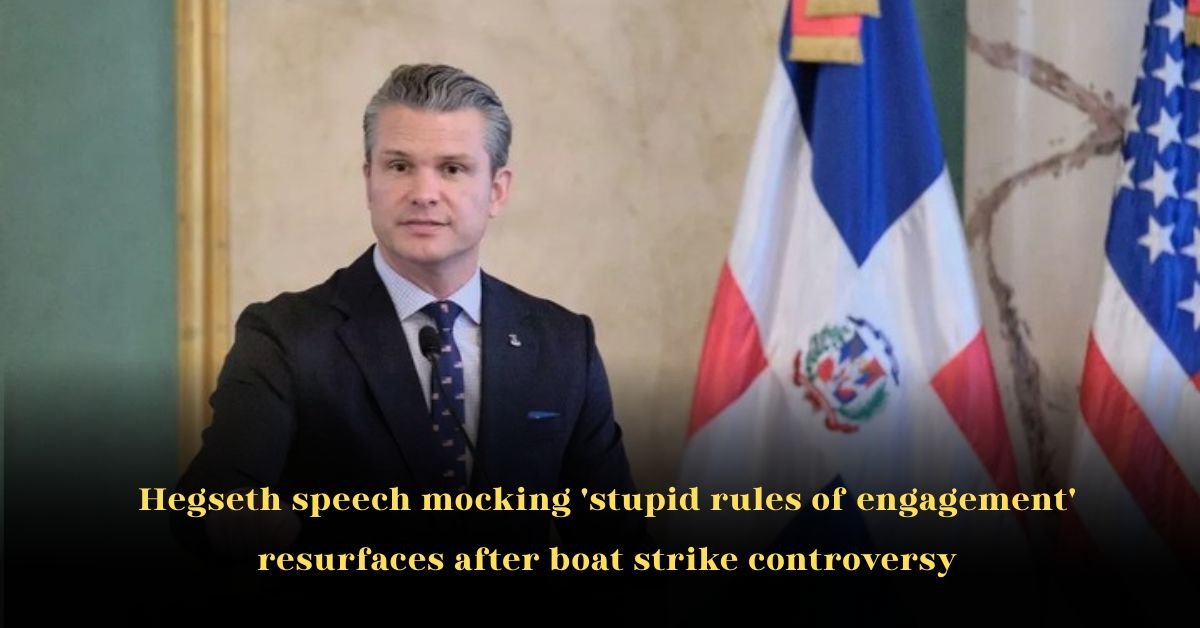
There is now a big argument about the Rules of Engagement (ROE) for the U.S. military. This argument grew after a naval strike that people are questioning. The debate became hotter because of old comments made by Secretary of Defense Pete Hegseth. The Washington Post reported that Hegseth verbally told forces to “kill everyone” during a naval strike on a suspected drug boat in the Caribbean Sea on September 2. Because of this report, his earlier words criticizing “stupid rules of engagement” have become important again.
The Quantico Address: Decrying ‘Politically Correct’ Standards
A few months before the naval operation that is now being checked very closely, Hegseth gave a speech. He spoke to over 800 high-ranking officers at Quantico, Virginia. In his speech, he talked about how he sees the future of U.S. military leaders. He complained that the military doesn’t focus enough on pure “warfighting.” He especially criticized the military’s physical-fitness standards and its programs for Diversity, Equity, and Inclusion (DEI).
But his strongest and most upsetting comments were about how military operations are guided. Hegseth said he wanted to move past what he called “politically correct and overbearing rules of engagement.” He told the senior leaders:
“We fight to win. We also don’t fight with stupid rules of engagement. We untie the hands of our war fighters to intimidate, demoralize, hunt, and kill the enemies of our country. No more politically correct and overbearing rules of engagement, just common sense, maximum lethality, and authority for war.”
This very strong talk clearly showed that he wanted a new, more aggressive way to run military operations. He wanted quick decisions and fewer limits that he saw as a burden or “woke.”
The Caribbean Strike and Allegations of ‘No Quarter’
These old comments are now being looked at again because of the deadly September 2 naval strike. This strike was against a boat suspected of drug trafficking in the Caribbean Sea. The original report claims that the first attack stopped the boat, and two people survived, holding onto the wreckage. It is also claimed that a high-ranking naval officer, Vice Admiral Frank Bradley, who worked for Hegseth, ordered a second strike to make sure no one lived. This was supposedly following Hegseth’s order to “kill everyone.”
Hegseth has publicly said these claims are “fake news.” He has also stated that the operations are “lawful under both U.S. and international law.” However, the event has caused wide worry and led to checks by Congress. The White House has tried to say Hegseth was not the one who ordered the second strike, saying he only approved the mission. Still, the disagreement shows a serious problem with the chain of command and the clear instructions for the operation.
ALSO Read: Spurs Players Are Actually Now Plotting to Make a Stand Against Their Own Fans
Legal Implications and International Law
The most serious issue from these claims is that they might mean there was a breaking of national and international law. Legal experts quickly pointed out that an order to show no quarter—meaning to purposely kill survivors or those who are hors de combat (out of the fight)—could be seen as a war crime or murder under U.S. and global laws.
The people on the vessel were suspected drug traffickers, not declared enemy fighters in a war. This means they were not targets under the Law of Armed Conflict (LOAC). After the boat was disabled, they should have been treated as criminal suspects or people who were shipwrecked. The rule against denying quarter is a basic idea in the laws of war. Its goal is to stop the killing of people who are no longer a threat. The Trump administration tried to say the strikes were justified by linking the drug traffickers to Designated Terrorist Organizations (DTOs). But lawmakers and experts on drugs are questioning this idea of calling all the killed people “narco-terrorists.”
The Broader Debate on Rules of Engagement
Many military experts see Hegseth’s demand to get rid of “stupid rules of engagement” as too simple and harmful. Rules of Engagement are more than just limits. They are tools that are both legal and political. They turn big goals—like keeping civilian deaths low, keeping international friends, and following the LOAC—into practical instructions for the fighters. They are created to prevent accidents that could make the conflict bigger and to make sure the military is held responsible.
Saying that the ROE are not important, especially to hundreds of top commanders, raises deep questions about whether the Pentagon’s military policies follow ethical and legal standards. Critics argue that this kind of talk risks hurting the professional values of the armed forces. It could possibly give an unspoken “green light” for actions that break the basic rules of fighting. This principle is now being tested in the investigation of the Caribbean Sea drug-trafficking boat strike.
Disclaimer
The news information presented here is based on available reports and reliable sources. Readers should cross-check updates from official news outlets.