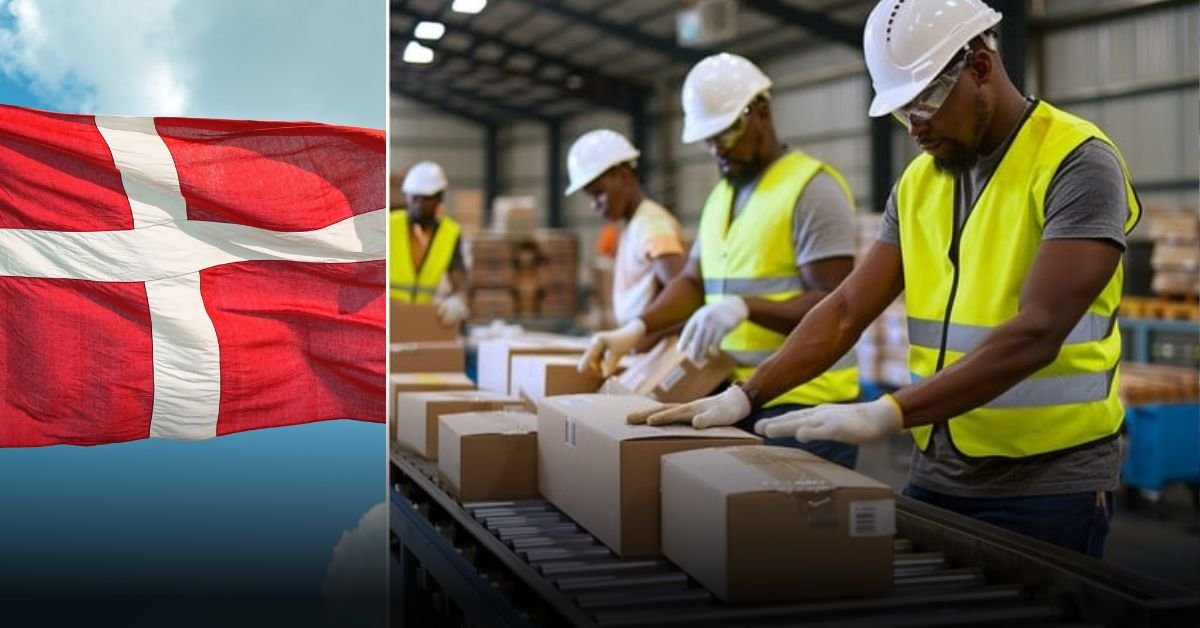
Dreaming of a good job with high pay and great work-life balance? Denmark is looking for people like you right now! Especially in Jutland (Jylland), many factories and warehouses need workers for production and packing jobs. These are called Produktionsmedarbejder and Pakkearbejde in Danish. This simple guide will show you how foreigners can get factory packing jobs in Denmark and the work permit you need.
The Key Challenge: The Work Permit Scheme
Denmark wants highly skilled people, but factory and packing jobs are not on the special “Positive List”. So you cannot use the easy high-salary scheme or the Positive List scheme.
The only real way for non-EU citizens to get these jobs is through a special rule called “Other Schemes”.
The “Other Schemes” Route for Factory Work
Your job MUST follow a Danish Collective Bargaining Agreement (Overenskomst). This is a contract between the employer and a big union (usually 3F – the workers’ union for factories).
This agreement decides your minimum salary, holidays, working hours, and many other rights.
Here is a simple table:
| Permit Scheme | What You Need | Good for Packing Jobs? |
|---|---|---|
| Pay Limit Scheme | Salary at least DKK 514,000 per year (2025) | No – too high salary |
| Positive List | Job must be on the official list | No – packing not listed |
| Other Schemes / Sectoral | Must follow Collective Bargaining Agreement | YES – best way |
Fact: Around 70% of all workers in Denmark are protected by these agreements. It is the main way Denmark protects workers.
Salary and Worker Rights: The Danish Model
Denmark has NO official minimum wage from the government. The salary comes from the union agreement (Overenskomst).
Hourly Wage Denmark Manufacturing
In factories and warehouses in 2025:
- Minimum hourly pay is usually more than DKK 140 (about €18.75).
- Most workers get more than the minimum because the company and local union agree on a higher rate.
- Normal week = 37 hours (not 40 or more like in many countries).
- You get 5 weeks paid holiday every year.
- Extra holiday money = 12.5% of your yearly salary.
- Company pays money into your pension.
Important Tip: When you get your employment contract (Ansættelseskontrakt), send it to the 3F union and ask “Does this follow the Overenskomst?” They will check for free and tell you if it is correct.
Step-by-Step SIRI Application Process
SIRI is the government office that gives work permits.
Here are the exact steps:
- Find a real Danish company that wants to hire you and is ready to follow the union rules. They give you a signed employment contract that shows salary, union agreement, and all benefits.
- Pay the fee and start the case The fee is about DKK 6,055 (2025 price). Your employer (or you) makes a Case Order ID on the website nyidanmark.dk (New in Denmark portal).
- Submit the online form Employer fills the AR1 online form and uploads:
- Your contract
- Passport copy
- Police certificate (criminal record) from your country
- Other documents
- Give biometrics After SIRI receives the application, you have to go to the Danish embassy or consulate in your country (or the nearest VFS center) and give fingerprints and photo.
- Come to Denmark and finish registration When the permit is approved, you can enter Denmark. Within 5 days you must:
- Register your address at the local citizen office
- Get your CPR number (personal number)
- Get health insurance card and tax card Without CPR you cannot open a bank account or get salary.
The whole process normally takes 1–3 months if all papers are correct.
Job Search Strategy and Key Regions
Where are the most jobs?
- Jutland (Jylland) – the biggest area for factories (cities like Herning, Horsens, Kolding, Aarhus, Aalborg)
- Triangle area (Trekantområdet) – Fredericia, Vejle, Kolding
- Odense on Funen island
- Near Copenhagen (for big logistics warehouses)
Best industries that hire foreigners for packing and production:
- Food companies (meat, dairy, biscuits)
- Medicine and pharmaceutical factories
- Big logistics and parcel companies
- Furniture and metal factories
Warning: Be very careful! If a job offer says “visa sponsorship, no Danish needed, start tomorrow” and never talks about Overenskomst or 3F, it is probably fake or illegal.
Only trust companies that give you a real contract that follows the union rules.
FAQ: Essential Information for Your Danish Move
Do I need to speak Danish?
For the first job in many big factories, English is enough. But you should start learning Danish from day one. Free classes are offered when you live here.
How long is the work permit?
Usually the same length as your contract, maximum 4 years at one time. Easy to extend if you still have the job.
What is the CPR number?
It is your personal ID number in Denmark. You need it for everything – salary, doctor, bank, phone contract, everything.
Can my family come?
Yes, if you have a work permit under the collective agreement and earn normal Danish salary, your husband/wife and children under 18 can usually get family reunion permits.
Is the job seasonal or permanent?
Most factory and packing jobs are permanent full-time contracts. Seasonal jobs are rare for non-EU workers because of the strict rules.
Ready to Build Your Career in Denmark?
Denmark gives you more than just money. You get:
- High salary for factory work
- Only 37 hours per week
- 5–6 weeks holiday
- Free health care
- Safe and clean working place
- Strong worker rights
If the company follows the union agreement (Overenskomst), your work permit is safe and legal.
Your next step today:
- Make a good CV in English (and later Danish)
- Search on websites like Jobindex.dk, Workindenmark.dk, and LinkedIn
- Contact big Danish companies directly
- Learn about the New in Denmark portal (nyidanmark.dk)
Start now – many factories in Denmark are waiting for hardworking people like you!
Dynamic Disclaimer
This information is only to help and educate you. Rules and numbers can change. Always check the newest information on the official websites: