community
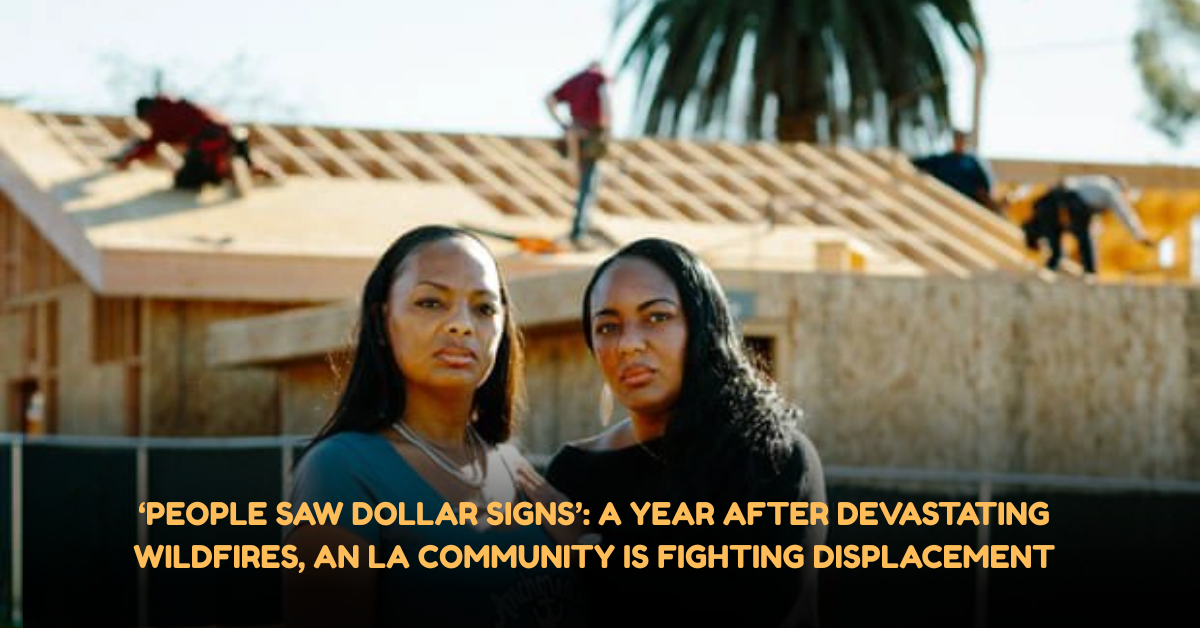
As survivors face pressure to sell their land in Altadena, a historic Black community, experts say we’re witnessing ‘climate gentrification’Ellen Williams’ left hand played with her long dark hair as her right hand guided the steering wheel, her phone resting face-down in her lap. Born and raised in Altadena, an unincorporated area in Los Angeles county, she didn’t need to look at a map as she drove to where her home of 22 years burned down.
Hammers Rang
We passed empty lots with gaping holes where foundations once stood. The banging of hammers rang through the neighborhood and wood frames rose from the dirt, the smell of fresh lumber in the air. Perched on street corners were signs declaring: “Altadena is not for sale.
Eaton Fire
The signs speak to an intrusion that has tormented Williams and other wildfire survivors over the last year: real estate investors aggressively pursuing their land.Williams’ family lost four homes in the Eaton fire, which killed 19 people and destroyed about 9,500 buildings. She received the first call from a real estate investor just two days after her home burned down. The call was from a representative of an investment group who knew her full name and asked if she wanted to sell her lot.
Community Is Experiencing
The calls haven’t stopped. “I got one of those calls yesterday,” she said as she drove. “Immediately people saw dollar signs.”Altadena is known for its thriving Black community that moved there when redlining kept them from buying homes elsewhere. Now, the community is experiencing what academics call “climate gentrification” as residents fight displacement.
Drowning Financially
Longtime residents who lost their homes are drowning financially due to insurance issues and the high cost of rebuilding, realizing they can’t afford to start over, and selling their land for less than it was worth when their homes were still standing.At the same time, real estate investors see Altadena as an opportunity. With ample land cleared by flames and bulldozers, they can buy discounted property in an urban area where it’s hard to find land to build. One recent survey found that real estate investors have bought up nearly half the empty lots in Altadena that sold after the fire.

ALSO READ: Tariffs don’t serve anyone’, Finnish PM says as criticism mounts on Trump’s threats over Greenland
Megaphones Blaring
Now police were driving down the street with megaphones blaring. “There were embers flying everywhere. It looked like a war zone,” Williams said. She sat at a restaurant near her house and watched as embers propelled by hurricane-force winds lit the palm trees like matchsticks. That’s when she realized no one was coming to save her home.
In the 1960s, Williams’ grandmother moved from Kentucky to California, settling in Pasadena, next to Altadena. But freeway construction displaced Black residents including the Williams family. Due to redlining, Black families couldn’t buy homes east of Lake Avenue, a major road that cuts through Altadena, so the Williams family bought homes on the west side.
Together, the freeway construction and redlining pushed the Williams family closer to the fire-prone San Gabriel mountains. Decades passed and climate change increased the fire risk, so when the Eaton fire broke out, it was Black households who were more likely to live inside the evacuation zone.
Cultural Historian
As we spoke on the phone, UCLA professor and urban cultural historian, Eric Avila, peered at historic, color-coded maps of Altadena on his screen. Avila noted that the area west of Lake Avenue in Altadena was marked in yellow, or “definitely declining”, in the redlining parlance of the time, meaning it carried significant risk to lenders. The area east of Lake Avenue was green and blue, meaning it was desirable, and Black families would likely have been blocked from buying homes there.
“There’s an inherent risk living in this wildland-urban interface zone on the edge of mountains,” he said. “The tragedy is that Altadena reflected an opportunity for a group of people that have experienced high rates of discrimination.”
10 Black-owned
As survivors seek to rebuild, signs of deep racial disparities are appearing. Nearly six in 10 Black-owned homes in Altadena sustained severe fire damage – the highest rate of any racial group, a UCLA analysis found. Most residents want to return, but nearly seven in 10 severely fire-damaged properties show no progress toward rebuilding. “Black homeowners in particular stood out as facing the greatest barriers,” Gabriella Carmona, the report’s lead author, said.
A real estate development company bought Troy Laster’s property after he lost his home of nearly 40 years in the fire. “They bought multiple [lots] on the block. I know for sure they got three, if not more,” he said. At first, he made a pact with his neighbors to rebuild, but later changed his mind. His wife struggled with trauma from the fire, toxic chemicals lingered in the soil, the rebuilding process felt daunting, and they would have had to pay rent and a mortgage for the duration of rebuilding. So they sold their property and moved to Las Vegas.