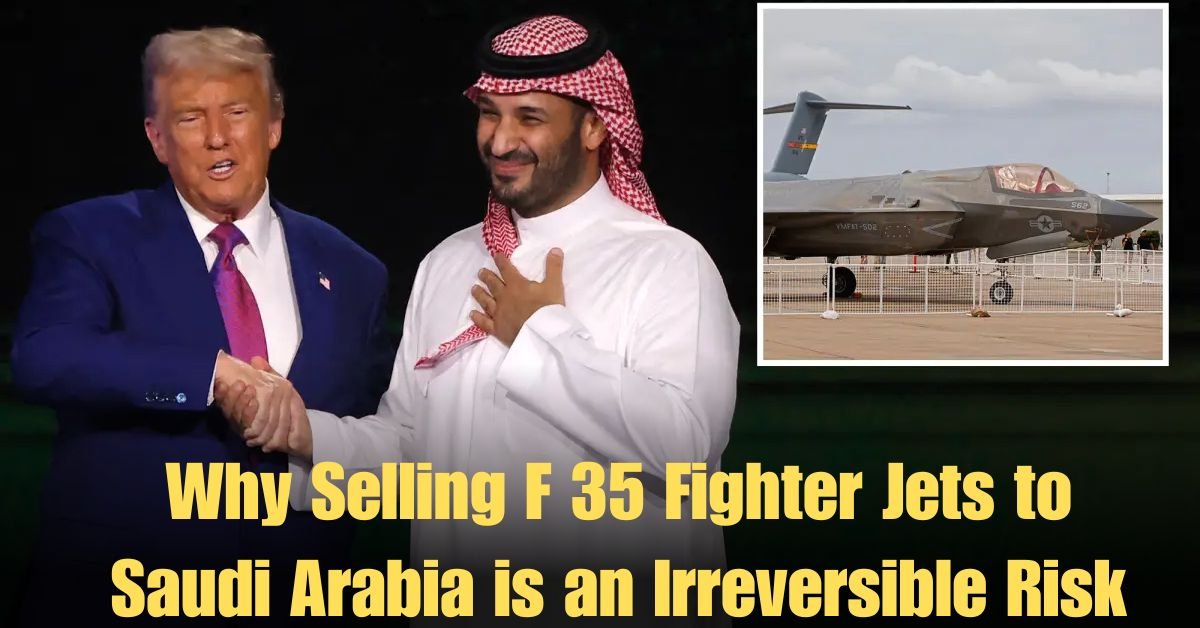
The Middle East security landscape is on knife’s edge and a proposed multi billion dollar arms sale threatens to destabilize it further. When President Donald Trump announced the potential deal to sell F-35 fighter jets the most advanced stealth and sensor technology the U.S. possesses to Saudi Arabia (Riyadh) it immediately drew a firestorm of controversy. This isn’t a routine transfer it’s a historic gamble that puts America’s technological edge and Israel’s security at profound risk.
The Autocracy Trap. Zero Long Term Certainty
At the heart of the argument against the sale is the fundamental instability of an authoritarian repressive monarchy. While current leaders like Crown Prince Mohammed bin Salman (MBS) may claim alignment with the United States history in the Middle East has proven that political winds can shift overnight.
- No Democratic Checks and Balances. The Saudi Arabia regime lacks the institutional stability of a democracy. There is zero long-term certainty of political continuity meaning that a future ruler or a popular uprising could seize control of these stealth F-35s.
- The Coup History. The Arab world is legendary for its revolutions and violent coups.Handing over such sophisticated systems means the United States could rapidly lose influence or control over them creating an irreversible strategic danger. The question isn’t whether the Saudis are friendly now but whether an autocracy can be trusted with systems when future use cannot be constrained.
The F-14 Lesson. A Warning from Iran
History offers a chilling precedent. Washington once sold the F-14 Tomcat to the Shah of Iran. Following the 1979 Islamic revolution those same jets became a powerful asset for a radically anti-American regime posing a security for decades threat particularly to Israel. This lesson should loom large as Congress considers greenlighting an even more advanced aircraft.
Undermining Israel’s Security & Qualitative Military Edge
A core tenet of U.S. foreign policy has long been maintaining Israel’s qualitative military edge (QME) over all regional rivals. The F-35 sale directly challenges this commitment.
- Proximity and Time. F 35 stealth fighter jets place in Saudi Arabia can reach Israel in minutes. This factor is given that Saudi Arabia still has no formal relations with Israel and continues to boycott Israeli products.
- Erosion of QME: For years Israel has been the sole operator of the F-35 in the region. Introducing the fifth-generation fighter to a close neighbor even a potentially friendly one, compromises Israel’s air superiority and intelligence gathering capabilities.
- Conditional Commitments. The allure of Abraham Accords style normalization from Riyadh does not outweigh the risk of undermining Israel’s security by surrendering America’s technological edge. As experts warn, the benefits of normalization are not worth the moderate risk of a future hostile regime armed with the most sophisticated aircraft ever built.
The China Problem. Compromise and Technology Leak
The dangers of the sale extend beyond the Middle East to global strategic competition specifically involving China.
National security officials are profoundly alarmed by possibility that Beijing could gain access to U.S stealth technology via Riyadh.
- Strong Saudi-China Ties. Reports suggest the F-35 tech could be compromised due to the deepening security and trade partnership between the two nations. China is Saudi Arabia’s largest trading partner.
- Weapon Transfer Risk: There is also a precedent for weapon diversion. In 1982 Israel seized American made M 16 rifles that had been originally sold to the Saudis demonstrating that Riyadh could potentially transfer some of these high tech supersonic stealth strike fighter/bombers to another country for political or financial gain.
A Call for Congressional Scrutiny and Strict Limits
The stakes are high for this to be treated as routine diplomatic favor or matter of short term geopolitical convenience or financial incentives. The multi billion dollar deal for Lockheed jets face urgent congressional scrutiny to prevent disastrous long term consequence.
Key Actionable Demands for Legislators:
- Exclude Sensitive Technology. Congress (Legislators) must insist that any final sale mandate strict limits on F-35 sales and exclude stealth sensitive technologies such as the full Block 4 capabilities or advanced long-range munitions to protect against technology leakage to China.
- Demand Accountability: The U.S. must include accountability mechanisms, such as “kill switches” or maintenance dependency that allow the Pentagon to monitor and potentially constrain the use of the jets if a regime change occurs.
- Act Now: Congress must act before contracts are signed and before jets are delivered. Once these advanced aircraft leave American control, the strategic danger is nearly irreversible.
Allowing a deeply authoritarian monarchy to obtain America’s most critical military asset is a historic risk that could haunt American and Israeli security for decades.
Also Read :Ty Cobb: ‘Silly’ to say Halligan ‘should be an assistant US attorney’
FAQs
Why the F 35 sale to Saudi Arabia so controversial?
It risks transferring America’s most advanced stealth sensitive technologies to an autocracy with unstable political future potentially undermining Israel’s security (QME) and allowing China access to U.S. stealth technology.
What historical model is cited?
The U.S sale F 14 Tomcat jets to Shah of Iran before the 1979 Islamic revolution. After revolution jets became key asset for the new anti American regime.
What is Israel’s main concern?
The sale erodes its long-standing qualitative military edge (QME) in the Middle East as the sole operator of the fifth-generation fighter. F 35s from Riyadh could reach Israeli airspace in minutes.
Has the deal been finalized?
While the Trump administration indicated its intent any arms sale of this magnitude requires final approval from Congress to move forward, making Congressional scrutiny vital.
Disclaimer:
This content is opinion piece and reflects specific political and security analysis concerning the potential arms transfer. It does not represent neutral or universally accepted consensus on U.S. foreign policy or the Qualitative Military Edge (QME) of regional actors.