The Constitutional Line: Why Service Members Must Refuse Unlawful Orders
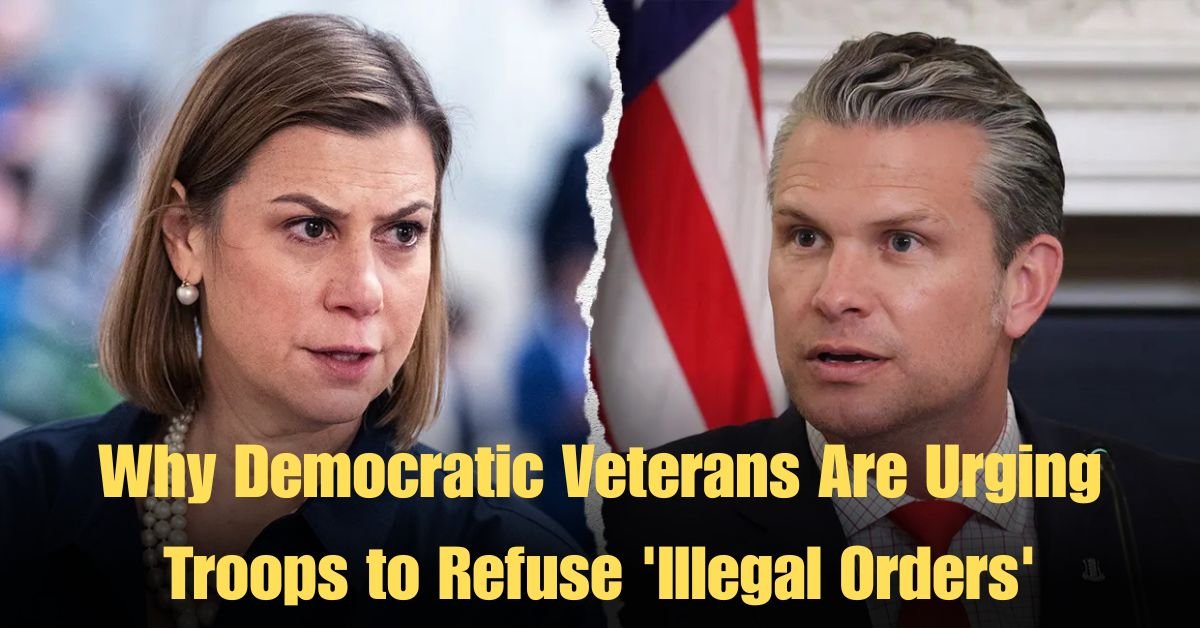
A highly charged video released by a group of Democratic veterans and former intelligence officers has ignited a savage political debate. Featuring prominent figures like Sen. Elissa Slotkin (D Mich.) and Sen. Mark Kelly (D Ariz.) the message was direct. Service Members have a duty to defy orders from the Trump Administration or any other authority if those directives are consider “illegal orders.
The core message is repeated emphatically in the video, is a stark reminder to all uniformed personnel: “You must refuse illegal orders. No one has to carry out orders that violate the law or our U.S. Constitution.”
This public call to stand up to Trump has elevated a crucial, yet often misunderstood the aspect of military law into the national spotligh the sworn Oath to the Constitution and the fundamental difference between lawful orders and unlawful orders.
The Legal Cornerstone: UCMJ and the Refusal of Unlawful Orders
The Democratic veterans’ appeal isn’t based on political opinion but on bedrock military law. The Uniform Code of Military Justice (UCMJ), specifically Article 92, mandates that troops must obey lawful orders but also disobey unlawful orders.
Legal experts, like those from the offices of military law specialists is confirm this non-negotiable legal obligation. An unlawful order is defined as one that clearly violates:
- The U.S. Constitution
- U.S. federal law
- International Human Rights Standards (including the Geneva Conventions)
- The legal authority of the issuing official
Examples of Unlawful Orders
What distinguishes a difficult order from an illegal one? Examples of orders that would be patently illegal and must be refused include:
- Intentionally targeting or harming civilians.
- Falsifying legal or operational records.
- Ordering the commission of a crime or war crime.
- Orders for personal services unrelated to military duty.
Crucial Takeaway: Military orders are generally presumed to be lawful.6 However, the Nuremberg defense “just following orders” is not a valid legal defense for carrying out an order that a person of ordinary common sense would know to be a crime.7 The consequences for troops who obey illegal orders can be severe to including Courts-Martial and prosecution by international tribunals.
Beyond Hypothetical: The Context Beyond the Urgency
The lawmakers many of whom are Democratic Veterans like Rep. Jason Crow (D-Colo.) argue that this reminder is not a theoretical exercise but direct response to highly actions and statements limit to the former President.
Specific instances cited as context for the video’s release include:
- Domestic Deployment: Past actions by the Trump Administration to Deploy National Guard troops and Send active duty Marines into U.S. cities is often in response to Peaceful Protests against police brutality, under the pretense of “Combating Crime.”
- The 2020 D.C. Incident: The mention of reports that President Trump allegedly questioned the use of force, such as the option to Shoot Unarmed Protesters in the leg, during the 2020 Washington, D.C., demonstrations.
- Military Operations: Questions surrounding the legality of Lethal Strikes on Drug Trafficking Boats in international waters which the administration defends as legal but critics view with caution.
Political Firestorm: “Insurrection” vs. The Oath
The video instantly fueled a significant Pushback from Conservatives. White House Deputy Chief of Staff Stephen Miller accused the lawmakers of “openly calling for insurrection.”
- Conservative Response: Figures like Defense Secretary Pete Hegseth dismissed the video as “Stage 4 Trump Derangement Syndrome (TDS),” attempting to frame the warning as a purely political attack rather than a statement on military law.
- Democratic Counter: The veterans immediately countered to clarifying that their intent was to support Service Members and reaffirm their oath. Sen. Mark Kelly posted a sharp reply: “I know the difference between defending our Constitution and an insurrection, even if you don’t.” The debate highlights the intense Political Polarization surrounding any action related to the former President.
The Democratic veterans’ core argument remains the purpose is to protect Service Members from being placed in an untenable legal and moral position by reminding them of their highest legal obligation to the U.S. Constitution itself.
Also Read: Kylie Kelce Reacts to ‘Smells Like Jason Kelce’ Candle: ‘I Know It Smells Married’
FAQs
What is main difference between a lawful and an unlawful order?
A lawful order is one that has proper military purpose is provide by skilled authority and does not conflict with the Constitution U.S. law or international conventions. An unlawful order is one that directs the commission of crime (e.g. murder, torture) or clearly break the U.S. Constitution or federal law.
What happens if I refuse an order that I think is illegal but court later finds it was lawful?
You can face severe penalties including Courts Martial and conviction under the UCMJ for failure to obey lawful order. Because orders are imagine lawful the burden of proving an order was patently illegal falls on the defense which is an exceptionally high legal standard.
Q: What should a Service Member do if they receive a potentially unlawful order?
A: If the order is not manifestly illegal (i.e., immediately obvious like murder) service members should, if time permits consult with a military defense counsel (JAG or civilian attorney). If the order is patently illegal (e.g., ordering the execution of unarmed non combatants) the duty to refuse orders is absolute.
Disclaimer
The information provided in this article “Why Democratic Veterans Are Urging Troops to Refuse ‘Illegal Orders’,” is for general informational and educational purposes only.It discusses legal concepts, including the Uniform Code of Military Justice (UCMJ), the difference between lawful orders and unlawful orders, and potential legal consequences.