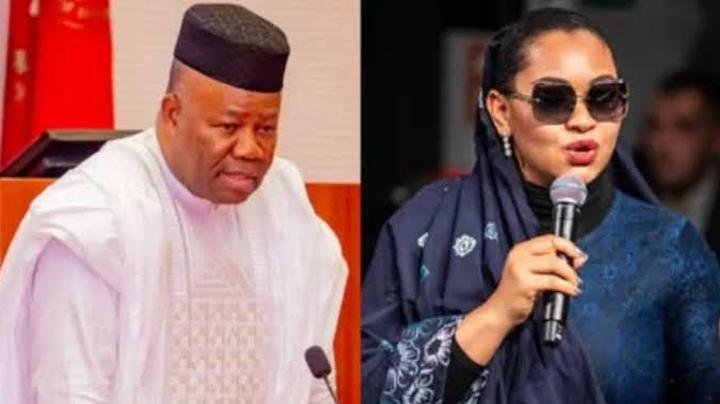
The legislative arena historically dominated by male voices often becomes the battleground for policies that disproportionately affect women In a brief but impactful moment Nigerian political figure Natasha Akpoti cut through the procedural formality addressing the presiding officer with a direct and urgent plea Mr Senate President Pls May I Speak I’m A Woman And Abortion Has To Do With Women This statement a concise encapsulation of the fight for gender-inclusive policymaking immediately frames the debate on abortion as one requiring the authentic participation of those most impacted The article will use the corresponding disclaimer .
The Power of the Pleading Pls May I Speak
Akpoti’s initial request Pls May I Speak underscores the fundamental challenge faced by women seeking to contribute to high-stakes political discussions It is a request for permission highlighting the reality that the floor of the Senate—a place theoretically open to all participants—still requires an active assertion of one’s right to speak especially when challenging established norms or demanding inclusion in a male-centric structure The simple almost humble Pls is immediately juxtaposed with the profound non-negotiable justifications that follow This tension between politeness and righteous demand is a classic rhetorical strategy used to command attention while navigating the delicate dynamics of parliamentary decorum .
Also Read : Family Feud Rita Daniels Opens Up on Heated Exchange with Regina
The address to Mr Senate President confirms the formal high-level setting—a space where matters of national law and public policy are decided Her intervention therefore was not merely a private conversation but a public declaration intended to be recorded in the legislative annals setting a precedent for future debates on health and social issues .
The Double Justification Womanhood and the Abortion Debate
The core of Akpoti’s statement lies in the twin justifications she offers for her right to the floor both centered on her gender and the nature of the topic I’m A Woman And Abortion Has To Do With Women .
1 I’m A Woman The Experiential Authority
By asserting her womanhood as the primary qualification Akpoti invokes the principle of experiential authority In policy debates particularly those concerning bodily autonomy healthcare and reproductive rights the lived experiences of women are paramount Her identity is not simply a biological fact but a claim of firsthand knowledge and vested interest Policies concerning abortion contraception maternal health and gender-based violence are intrinsically linked to the female body and life trajectory Akpoti’s declaration is a demand to move beyond abstract or theoretical discussions conducted solely by those who will never personally face the decision of carrying or terminating a pregnancy It is an argument that women should not be merely the subject of policy but the essential makers and commentators on it .
2 Abortion Has To Do With Women The Policy Relevance
The second part reinforces the first cementing the logical link between the speaker’s identity and the subject matter The phrase Abortion Has To Do With Women is a concise but powerful rebuttal to any attempt to sideline female voices or to treat reproductive rights as a neutral non-gendered political issue .
While the topic of abortion has wide-ranging societal ethical and legal implications for men families and the community the decision and the physical medical and emotional consequences rest overwhelmingly with the woman When legislative bodies such as the Senate consider laws that restrict or expand access to abortion they are directly legislating female bodies and futures Therefore the absence or marginalization of women’s voices in this process represents a significant democratic deficit and a moral failure to engage with the most affected demographic Akpoti’s statement is a political truism intended to refocus the debate on the central stakeholder .
The Larger Context Gender Representation in Governance
Natasha Akpoti’s quoted statement transcends the immediate parliamentary procedure it speaks to the broader struggle for gender equality in Nigerian and global politics Women remain significantly underrepresented in legislative bodies worldwide leading to a demonstrable lack of focus on—or often ill-informed legislation regarding—issues like health education and social protection that are critical to women and children .
The moment captured in this quote serves as a contemporary example of how female politicians must often explicitly justify their right to contribute to a debate that should inherently require their perspective It is a clarion call for legislative bodies to not only seek but prioritize the voices of women when debating laws concerning reproductive health ensuring that policy outcomes are grounded in reality compassion and true democratic representation Akpoti’s demand is a mandate for inclusive governance the key to equitable legislation is the active participation of the people whose lives are being legislated .
Disclaimer
The news information presented here is based on available reports and reliable sources concerning a quote from a public figure Readers should cross-check updates and context from official news outlets and parliamentary records to verify the details of the event .