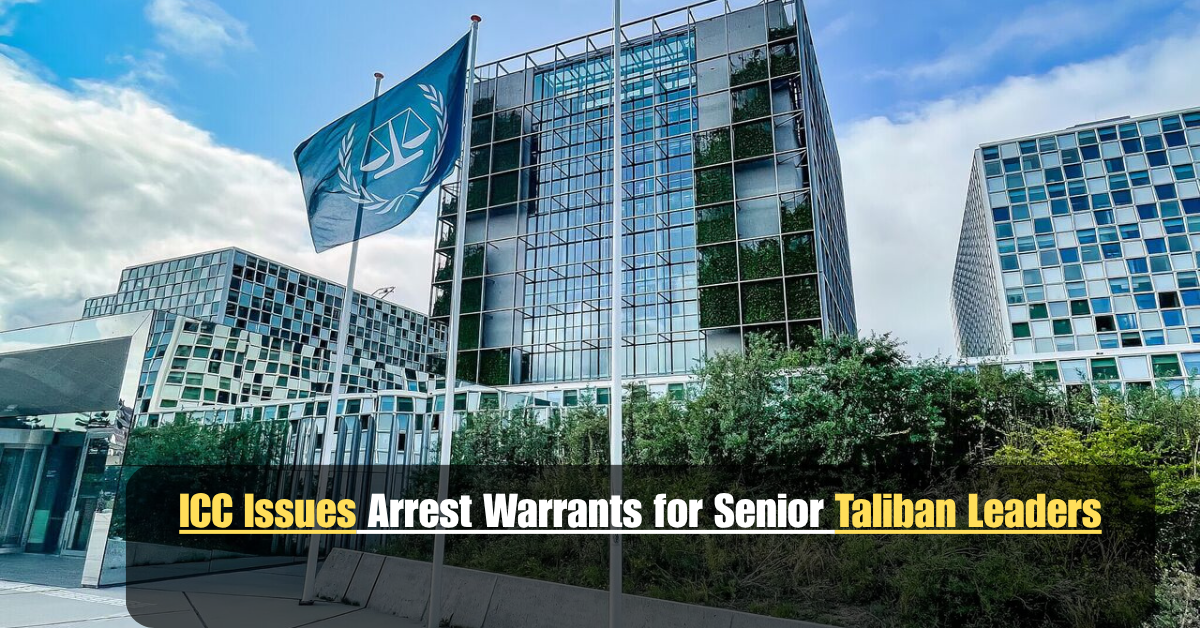
In a groundbreaking development the International Criminal Court ICC has issued arrest warrants for senior Taliban leaders This move marks a significant step in international justice efforts focusing on accountability for war crimes and crimes against humanity committed during the Taliban’s reign in Afghanistan
The ICC headquartered in The Hague Netherlands is responsible for prosecuting individuals for genocide crimes against humanity war crimes and the crime of aggression Its recent action against the Taliban leadership underscores the international community’s growing determination to address serious human rights violations committed in Afghanistan
Details of the Arrest Warrants
According to official sources from the ICC the warrants target several high ranking members of the Taliban although their specific identities have not yet been publicly disclosed The charges reportedly include crimes such as unlawful killings torture forced displacement persecution of women and minorities and attacks on civilian populations
The warrants are connected to incidents dating back to both the Taliban’s earlier rule from 1996 to 2001 as well as their most recent actions following the takeover of Afghanistan in August 2021 The ICC’s investigation reportedly covers a wide range of violations including attacks on schools suppression of women’s rights and extrajudicial executions
Also read:Minister of Energy Makes Major Announcement for Electricity Consumers Using Up to 200 Units
Background of the ICC’s Involvement in Afghanistan
The ICC opened an investigation into alleged war crimes and crimes against humanity in Afghanistan in 2020 The courts focus initially included crimes committed by all parties to the conflict including the Taliban Afghan government forces and foreign military personnel
However after the Taliban regained control of Afghanistan reports of widespread human rights violations surged The ICC Prosecutor announced an intensified focus on crimes committed by the Taliban and Islamic State Khorasan Province ISISK citing the gravity of crimes and scale of victimization
This shift in focus has been controversial as it involved deprioritizing investigations into alleged abuses by US and Afghan government forces in favor of concentrating on Taliban linked atrocities Nonetheless many human rights advocates welcomed the ICC’s recent move arguing that it signals a commitment to holding powerful actors accountable for egregious violations
Taliban Response
As expected the Taliban has rejected the ICC’s jurisdiction over Afghanistan A Taliban spokesperson dismissed the court’s action as politically motivated and claimed that Afghanistan is governed by Islamic law making foreign courts irrelevant in their eyes
The Taliban’s position reflects a longstanding refusal to recognize the authority of international courts Nonetheless international legal experts note that ICC arrest warrants are legally binding on all 124 member states under the Rome Statute which established the court
This means that if any of the wanted Taliban leaders travel to a country that is a member of the ICC they could face immediate arrest and extradition to The Hague
Implications and Reactions
International human rights organizations have largely praised the ICC’s decision Amnesty International Human Rights Watch and other groups have stressed the importance of accountability for crimes against women ethnic minorities and civilian populations in Afghanistan
Experts say the move sends a strong message to the Taliban leadership and other groups involved in grave abuses It demonstrates that the international community will not turn a blind eye to systematic violations of international law
However some critics argue that enforcement will be difficult With the Taliban firmly in control of Afghanistan and refusing to cooperate with foreign courts it remains uncertain whether any arrests can realistically take place in the near future

Despite these challenges the issuance of the warrants represents a symbolic victory for victims of Taliban atrocities and their families It highlights the persistence of international justice mechanisms in the face of political and security obstacles
Conclusion
The ICC’s issuance of arrest warrants for senior Taliban leaders is a historic and consequential move in the ongoing fight for justice in Afghanistan While the practical challenges of enforcement remain significant this step signals an important effort to hold perpetrators of war crimes and crimes against humanity accountable on the global stage The development is likely to have lasting implications for international law Afghan society and the Taliban’s global standing